
 Written by: Rebecca Sprengel
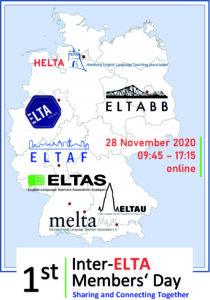
When so many aspects of life are being reduced, it is hard to find something really new. Well, the first inter-ELTA online conference was, if I’m not mistaken, a world premiere! 7 ELTAs, 8 speakers and over 60 participants spent a whole Saturday listening, talking and chatting about a huge variety of topics. These were: Marketing Yourself, Universal Design for Learning, Screencasting, BE material, Articulation, Fighting fossilisation, Teaching English through Food and Caring for your Voice. Slides were made available, we chatted in breakout rooms, and just when we felt the last drop of energy draining away, Frances Lucey, English teacher and soprano at the Bavarian State Opera got us all alert again. We stood up and did some loosening up exercises, followed by a number of vocal warm ups. Finally, as a reward, she sang “Away in a manger” so beautifully that we all had goose bumps.
The first inter-ELTA day was such a success that, not surprisingly, the next one is already in the pipeline. Read the reports of various talks written by your ELTAS committee members.
|
Business English Material – Where are we now? As a business English trainer, writer and former BESIG Coordinator, I was especially interested to hear what Evan Frendo had to say about Business English Materials. In his very professional talk, he told us that “most big publishers produce business English materials, yet many trainers claim to rarely use them”. He looked at good practice in current BE teaching materials and concluded with a checklist of key criteria: needs based, authentic language, relevant business content, multimodality, flexibility and ease of use. He went on to tell us that our clients need “language of doing business” rather than “language of talking about business”. Some examples of language of doing business are: socialising and small talk, emails, meetings with suppliers, presentations and reading contracts. He surprised a lot of us when he said that the use of the first conditional is not commonly used in authentic business communication. Publishers are now producing in-company and tertiary material in one pack, less ESP books and targeting the adult market as a whole rather than just BE learners. Not surprisingly, technology is playing an increasingly important role with blended learning, online delivery and “Pepper”. A robot teaching assistant who can speak up to 15 languages and provide translation via Cloud services – and, Evan emphasised, is much more patient than a human. Will Pepper take over?
|
|
Screencasting – how to use video to give corrective feedback on written work With her very enthusiastic and motivating talk, Claire Smith introduced www.screencast-o-matic.com to the participants. Claire Smith recommended starting the video feedback by first saying what was good in the student’s written text before starting with your corrections and explanations…
|
|
Language production – slips of the tongue The deputy chair and very dedicated ELTAS-member Andrea Vogt-Nas talked about language production often causing slips of the tongue. She has a background in psycholinguistics and many years of experience in working on speech production of students of all ages.
|

No Comments Yet