Break the ice – Crack the discourse
A workshop with Andy Vogt-Nas on 19th September 2026 at ISM Stuttgart
Workshop review written by Alexandra Swan
We were treated to another informative presentation today. This one was on icebreakers to use in the classroom, especially useful at the start of a new term with new students.
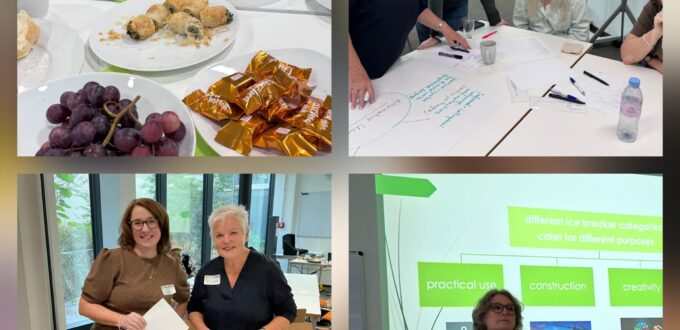
First up, a toilet roll was passed around the audience with the only instruction being to take as much as you need and pass it on. This had us confused and intrigued. But no time for an explanation as it was now onto “scissors, paper, stone” as a physical icebreaker, potentially needing very little language. However, with our group it generated lots of chatter before we circled back to the toilet paper. On this we were told that we now needed to turn to our partners and tell them information about ourselves. If we had 2 sheets, we needed to tell them 2 things and so on. Another participant followed this up with a similar idea. Hand out a bag of M&Ms and each should help themselves. Then explain that for every yellow M&M, you need to tell your partner something about a hobby, and for every blue one, a childhood memory, etc.
Next up, Andy explained how she categorised icebreakers into 4 groups: Practical, Creative, Storytelling, and Construction. Now it was our turn. We got ourselves into groups and were given instructions for an icebreaker in the particular category to which we had been assigned:
Practical Use e.g. come up with 5 everyday objects, select one and come up with alternative uses for it. The group chose a paperclip and unfolded it to use it to be able to access hard to reach places, for example.
Construction e.g. the marshmallow challenge, see Tom Wujec’s TED talk on this for more info.
Creativity e.g. funny walks like Michael Jackson’s moon walk, do the moon walk, and giggle every few seconds.
Storytelling e.g. Sound Jam: In turns, each person should utter a sound/noise/onomatopoeic words e.g. woo oooo, boo, shhhh. Then the group had to come up with a story to link these sounds together – a bird calls as it flies (woo ooo), lands on the verandah (boo) where the mum sees it and warns her child to be quiet to not frighten the bird (shhh).
After explaining our icebreakers to the other groups, we then analysed, with the help of guide sheets divided into a) language use b) phonological elements c) speaker roles d) intercultural communication, how and what language we had used during the task. This was rounded off by a SWOT analysis of these example icebreaker activities, as to what Strengths, Weaknesses, Opportunities and Threats they offered in the classroom.
We also discussed when and how icebreakers could be used in a lesson – just at the start, or even for the whole lesson if there was one issue in particular you wanted to focus on, e.g. a phonological one. Then came the alternative name for them – energisers, to try and bring life back to a flagging class, maybe after lunch or in the middle of a very long class.
The timing of this event was perfect, just before the start of the academic year and for those affected by that. The atmosphere and energy reflected our readiness for more after the summer break! Thanks Andy!
